
CARTONS & COMPONENT FIT
How to Size a Cosmetic Carton Around a Bottle with Its Pump Fitted
A carton can fit the bottle body and still fail to fit the finished product. Start with the assembled bottle, pump and protective components, then confirm the structure with a physical sample.
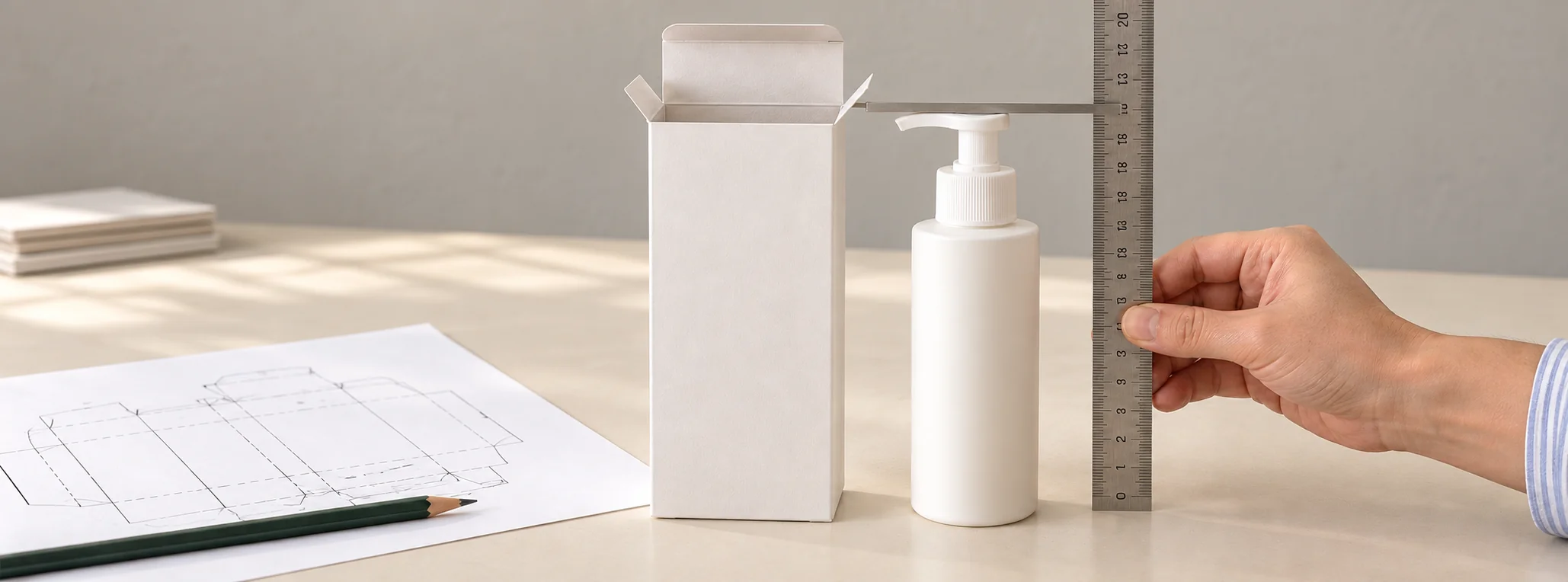
Start with the bottle as it will be packed
A bottle drawing is only one part of a carton brief. The pump, cap, protective clip or overcap may change the height and the widest part of the packed product. Before measuring, fit the components that will actually be supplied and agree how the assembly will sit inside the box.
Record whether the pump is locked down or in its raised position, where the nozzle points and whether a clip or cover is included. If the packing team must turn a nozzle to load the bottle, that orientation belongs in the packing instruction. Do not size the carton around an arrangement the production team cannot repeat.
Use the current component revision. A change of pump after box approval is a reason to recheck the fit, even if the bottle and stated capacity stay the same.
Record the assembled height and widest footprint
Measure from the base to the highest point of the assembled product in its intended packed state. Then record the maximum width and depth, including any projecting nozzle. For a round bottle, the body diameter alone may not describe the space the complete pump assembly occupies.
Send an annotated front and side view with dimensions in millimetres, plus a photo showing the packed orientation. State which measurements are nominal drawing values and which were taken from a physical sample. Where available, include the component tolerances or dimensional range so the carton is not designed only around one unusually small sample.
For example, a 45 mm bottle body could have a pump projecting beyond that diameter. The useful question is the overall footprint of the assembly, not whether a 45 mm-wide box can hold the bottle body. This is an illustrative example, not a specification for a LANYU product.
Keep product size, internal box size and external box size separate
Label all dimensions explicitly. The product envelope is the space occupied by the assembled item. Internal box dimensions describe the available space inside the carton. External dimensions describe the finished box footprint, which matters for shipping-case layouts and storage.
Do not write only “50 × 50 × 180 mm” without stating the units, dimension order and whether those are product, internal or external measurements. Mark length, width and height on the agreed structural drawing rather than assuming both sides use the same convention.
Packly’s box-sizing guidance starts from the actual dimensions of the contents. Its dimension explanation also distinguishes usable internal space from the external footprint. Apply that distinction to your brief, then have the carton designer confirm the construction-specific dimensions.
Allow for the insert, closure and packing operation
An insert occupies space as well as holding the product. Specify whether the carton contains a single bottle, a bottle and leaflet, or several items, and share the intended insert concept. Ask the designer to review the complete arrangement, including how the product is loaded and removed.
Check where the insert supports the bottle and where the carton closes around the pump. The design should avoid unintentionally pressing the actuator or forcing the nozzle into a panel. A box that closes only when the bottle is squeezed into position needs further review.
There is no universal “add 2 mm” rule for this guide. The working allowance depends on the component variation, board and insert construction, folded features and packing requirements. Ask the supplier to propose the allowance, identify what it covers and confirm it with a physical sample.
Do not calculate the final dieline by simply adding a fixed amount to the bottle dimensions. The designer must translate the agreed usable space into the selected carton structure.
Check a white sample with the real assembled product
Request a plain structural sample, often called a white sample, before locking the artwork to a dieline. Confirm whether its board, thickness, insert and construction represent the proposed production pack. If they differ, record what this sample can and cannot establish.
- Load the bottle in the planned orientation without forcing it.
- Fit the leaflet, clip and other included items.
- Close the top and bottom fully; look for panel bulging or pressure on the pump.
- Check that the insert holds the product as intended and that removal is practical.
- Review several representative assemblies where available, including relevant dimensional variation.
- Confirm the final retail-box dimensions before planning the outer shipping case.
A white sample checks structure and fit. It does not by itself approve printed colour, metallic decoration, formula compatibility or transport protection. Agree any additional checks needed for the packed product and its shipping arrangement.
Approve the structure before releasing final artwork
After the fit review, record the carton drawing revision, bottle and pump references, packing orientation, insert revision and sample approval date. Ask for the final dieline before completing artwork placement. If the structure changes, check which panels, folds and artwork positions are affected.
Keep structural approval and print approval identifiable. A useful instruction might read: “Size the carton for the attached assembled bottle in the locked-pump position, with the specified clip and leaflet. Please propose internal dimensions and an insert, then submit a plain sample for fit review before final artwork approval.” This is a brief template, not a finished dimensional specification.
LANYU’s carton production workshop supports structural design, printing, die-cutting, folding and gluing. Send the complete product information so bottle and carton decisions can be reviewed together.
Need a carton for your bottle or jar?
Share the assembled product dimensions, component references and estimated quantity. Include a physical sample or annotated views when available.
Contact Our Team