Material selection
PET, PETG, PP or Glass: Start with the Packaging Brief, Not the Material Name
Compare LANYU packaging options through actual formats, capacity labels, closures and order quantities before requesting samples.
First, define what the container must do
A material name is not a complete packaging specification. Before choosing PET, PETG, PP or glass, describe how the customer will use the product: dispense it through a pump, spray it, pour it or scoop it from a jar. Then identify the intended fill quantity, closure and presentation. This gives a supplier something more useful than a request for “a premium bottle.”
For a coordinated range, make a separate line for each product. A lotion bottle and a cream jar can share an artwork direction without sharing the same material, closure or minimum order quantity.
Compare actual designs, not a generic material ranking
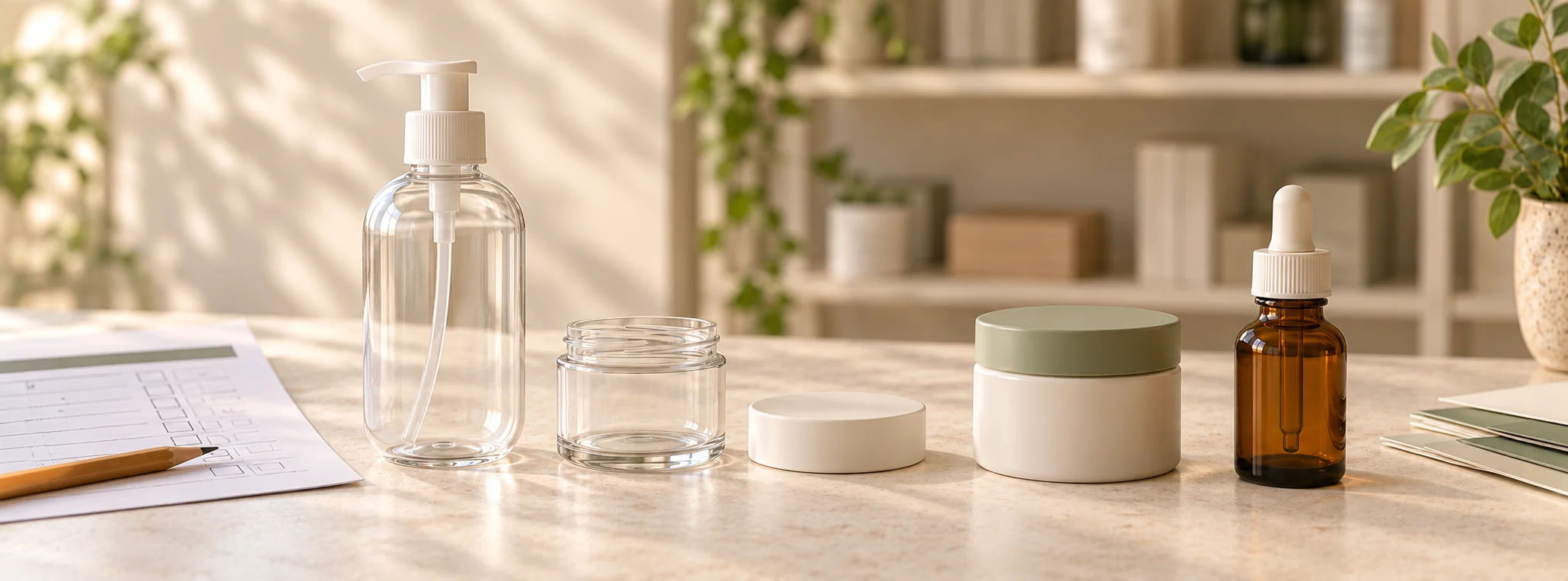
Our 260 ml PET bottle is offered with a screw-cap format, while the 150 ml PETG design uses a pump. Choosing between these two involves both capacity and dispensing format; it is not simply a PET-versus-PETG decision.
The PP CA jar series has size designations from 5 g to 100 g. Those gram labels should not be read as millilitres or as the empty container's weight. Confirm the usable fill with your actual product. Our glass collection includes several bottle sizes and closures as well as jars, which need their own specification review.
Keep minimum quantities attached to the design
The listed 260 ml PET bottle has a 10,000-piece minimum. The 150 ml PETG model also starts at 10,000 pieces per model. The 500-piece minimum applies to the specified PP CA stock series, not every custom PP project. Glass bottle orders start at 3,000 pieces, with final terms depending on the selected design and decoration; glass jars are quoted separately.
For illustration, a brief for 3,000 bottles split across three colors should state 1,000 pieces per color. Do not assume that the combined quantity satisfies a model's color or decoration minimum. Ask for those conditions in the quotation.
Approve the assembled sample
Request the bottle or jar together with its intended closure. Review dimensions, dispensing, artwork placement and the way the pack fits its carton. Ask which formula-compatibility checks are needed for your product; a material label alone is not approval for a particular formula.
Bring the shortlist back to four questions: Does the format suit use? Does the assembled sample meet the brief? Is the quantity workable? Can the container and box be approved together? Those answers are a stronger purchasing basis than choosing a material from appearance alone.
Put your packaging brief into focus.
Share the design, quantity and details you have. Identify the decisions you would like us to help review.
Discuss your projectContinue reading
- Custom Bottle Molds: Separate Design Approval, Trial Samples and Production Tooling
- Screen Printing, Hot Stamping or Spray Finishing: How to Write a Clear Decoration Brief
- A Bottle, a Pump and a Box: What to Include in One Packaging Quotation Request
- Custom Cosmetic Cartons: From Product Fit to Printed Packaging at LANYU