
COMPONENT SELECTION & SAMPLE REVIEW
How to Choose Pumps and Closures for Cosmetic Bottles
A pump can screw onto a bottle and still be the wrong choice. Before approving its colour or silhouette, answer four separate questions: does it fit, does it dispense your formula, does it work through everyday use, and does the assembled pack suit your delivery route?
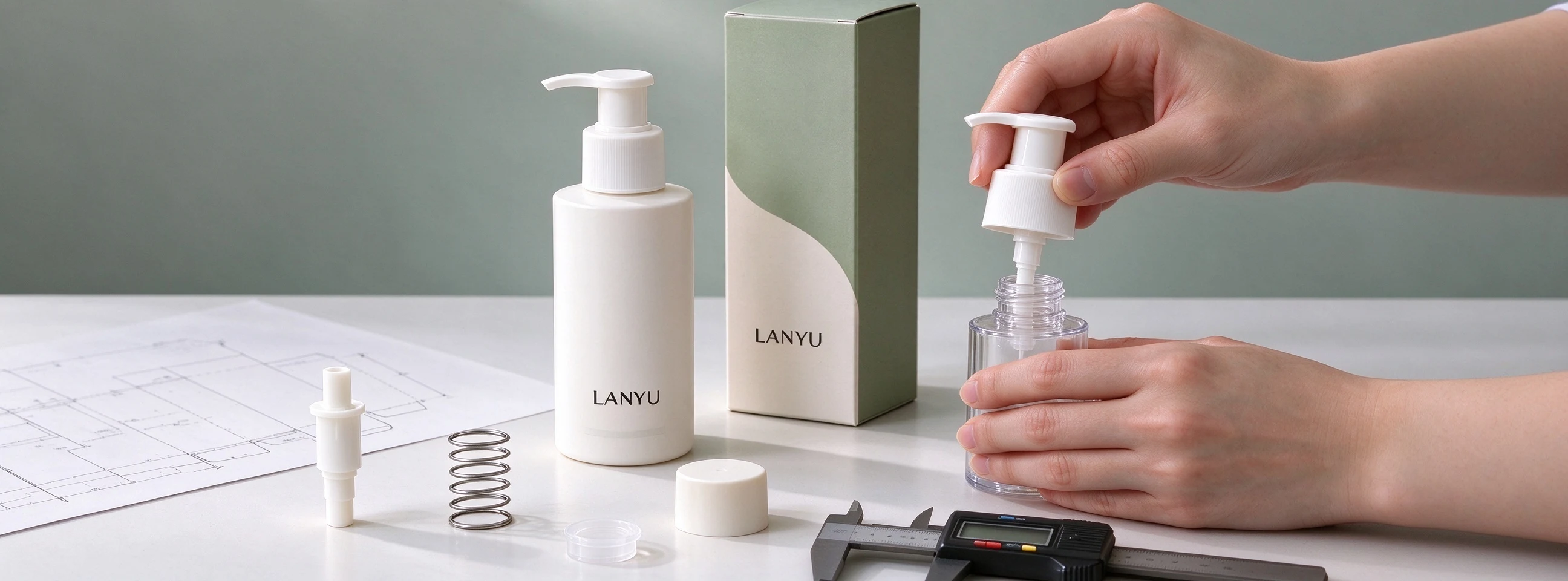
1. Start with the way the product will be used
“We need a premium pump” describes a look, not a dispensing requirement. Begin with the action you want: a measured portion in the palm, a mist across a surface, foam, a few drops, or a product squeezed through an opening. Then shortlist mechanisms with the supplier.
- Lotion pump: a starting point for products dispensed in portions, such as lotions or washes. The selected mechanism still needs review with the formula.
- Fine-mist sprayer: consider when a spray is the intended application. Evaluate the pattern and user experience with the actual liquid, not just water.
- Foamer: investigate when foam is part of the product experience. Do not assume an ordinary wash becomes suitable simply by replacing its cap with a foamer.
- Dropper: consider for controlled, small applications. Check pickup, release and the bulb or other dispensing mechanism with the intended product; a drop is not a universal volume.
- Flip-top, disc-top or screw cap: appropriate candidates when pouring, squeezing or opening the container suits the use. The opening and seal need review alongside the bottle.
These are selection prompts, not a formula-to-closure compatibility chart. Explore the available pumps and closures, then narrow the choice using physical requirements.
2. Read beyond the bottle-neck diameter
A request for a “24 mm pump” is incomplete. In a designation such as 24-410, the diameter and finish series both matter. Matching the name is a useful starting point, but the bottle and closure drawings provide the dimensions needed for review.
Thread engagement, finish height and sealing surfaces are separate details. A closure that turns onto the neck is not proof that its sealing arrangement works as intended. Ask for the bottle drawing, closure specification and the proposed liner or sealing design, where applicable. Agree assembly conditions with the supplier rather than tightening a sample by feel.
Berlin Packaging’s neck-finish guide explains the different dimensions used to describe a finish. It is a helpful reference for why a single diameter measurement cannot describe the whole connection.
3. Bring the actual formula into the decision
Do not approve a dispensing mechanism only because an empty sample feels smooth. Tell the supplier how the product behaves and arrange evaluation with the intended formula. Where viscosity data is available, include the measurement conditions; an isolated number is less useful than a documented result.
Discuss the desired amount per use before selecting the output per stroke. A nominal dose in a catalogue is a specification to investigate, not a promise that every formula, partial press or usage condition gives the same result. Record the selected pump version and the test procedure used to evaluate it.
Also identify product-contact materials and ask the formulation team which compatibility checks are needed. Do not assume that choosing a bottle resin answers questions about the pump’s internal parts, seals or other contact surfaces. Aptar’s Evolution product information, for example, lists dose and pathway options separately. Those are examples of selection variables, not specifications for LANYU’s range.
4. Treat the dip tube as part of the assembly
For a dip-tube pump, the tube specification belongs to a particular bottle-and-pump combination. Two bottles with the same stated capacity can have different internal depths and base shapes. Equally, two bottle sizes may share a neck finish without sharing a tube length.
Ask the supplier to define the tube measurement reference, length and end configuration for the selected assembly. Check its position in a physical sample instead of applying a universal clearance from an internet diagram. During dispensing review, observe product pickup as the fill level falls and record how much remains under the agreed use conditions.
If the bottle, pump housing or tube specification changes, review the combination again. Keep the old and new component references distinct; “same white pump” is not enough to identify a revision.
5. Keep four approval decisions separate
Use a short review record with four headings. This prevents a good result in one area from being mistaken for approval of the whole pack.
- Fit: identify the bottle and closure versions, review engagement and sealing, and record the agreed assembly settings.
- Dispensing: observe priming, output, spray or foam quality where relevant, actuation and behaviour after a pause, using the intended product.
- Use over time: agree a formula-compatibility and functional review with the appropriate technical team. Define storage conditions, duration, sample count and acceptance criteria for the project.
- Delivery: evaluate the assembled, filled and packed configuration against the intended shipping conditions. Include the pump’s transport position, protective parts and outer packaging.
A lock, clip or overcap may help address accidental actuation, but it should not be treated as proof of leak-free shipping. A hand squeeze or a brief inverted check is also not a substitute for an agreed transport evaluation. Confirm which checks your project requires and who will perform them.
Keep “appearance accepted,” “dispensing accepted” and “transport review complete” as separate decisions. This checklist is a planning tool, not a claim that every LANYU order undergoes the same laboratory test.
6. An example: two sizes, one-looking pump
Imagine a brand selecting a 100 ml travel bottle and a 250 ml bathroom bottle with visually matching pumps. This is an illustrative scenario, not a customer case.
The design team may want identical actuator shapes and colours. Procurement still needs to establish whether the neck specifications match, whether separate tube lengths are required, and whether the intended dose makes sense for both uses. The travel bottle may also raise different locking and packing questions.
A useful approval note would name each bottle, its pump configuration and the outstanding checks: “Appearance accepted for both sizes. Confirm tube specifications separately. Dispensing review requires the intended formula; travel-pack review remains open.” That is more actionable than “pump approved” on a photograph of the two bottles.
7. Send a usable selection brief
You do not need to settle every technical point before contacting a supplier. Separate what is fixed from what needs advice:
- Product: intended use, formula type and relevant formulation information available for review.
- Bottle: material, capacity, model or drawing, neck-finish designation and whether an existing bottle must be retained.
- Dispensing: desired action, target amount per use and any usability requirements.
- Presentation: actuator style, colour and decoration references, with essential features distinguished from preferences.
- Delivery: sales channel, expected shipping route, lock or overcap preference and carton or insert constraints.
- Order: quantities by bottle size and variant, sampling needs and target schedule.
- Approval: who supplies the filled samples, who evaluates them and which decisions remain open.
If neck information is missing, say so and provide a drawing or physical sample when possible. A photograph helps identify the style but should not be used as a substitute for dimensions. For the wider bottle, decoration and box requirements, use the complete packaging quotation checklist.
8. Questions before you approve
Can the same pump be used on PET and glass bottles?
Possibly, but the material name alone does not settle the choice. Review the actual neck geometry, sealing arrangement, assembly and formula performance of each combination. Start with the selected PET bottle or glass bottle, not a general material assumption.
Does a successful water trial approve my lotion?
No. It can show operation with water under those conditions, but it does not establish how the intended lotion will dispense or interact with the packaging over time.
Can a replacement pump skip sampling if it looks identical?
Appearance does not identify internal construction. Compare the supplier’s component references and specifications, then determine which fit, dispensing and compatibility checks need repeating.
Should I approve the box before selecting the closure?
Confirm the assembled dimensions and transport configuration first. A taller actuator, overcap or different locking position may affect the insert and box. See the pump-bottle carton sizing guide before finalising the secondary packaging.
Choose the assembly, not just the pump
Send your bottle reference, intended product, dispensing preference and estimated quantity. Tell us which components are already fixed so the discussion starts with the combination you actually need.
Discuss Your Bottle & Closure