Capacity & packaging fit
150 ml or 260 ml? How to Choose a Cosmetic Bottle Size
Choose a cosmetic bottle size by checking intended fill, nominal and brimful capacity, closures, dimensions and complete packaging costs.
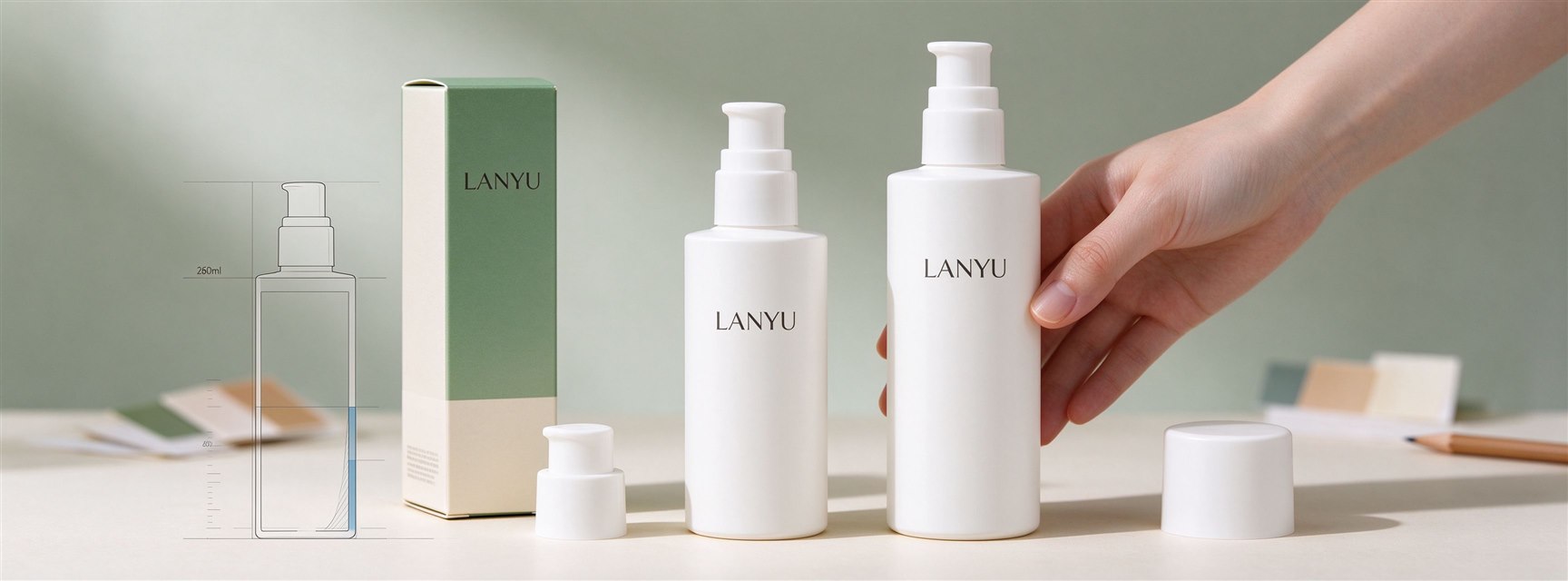
Choosing a cosmetic bottle size starts with the amount of product you intend to sell and how customers will use it. The bottle also needs to work with your formula, dispensing method, artwork and outer packaging.
A 150 ml bottle and a 260 ml bottle are useful starting points for a comparison, but capacity alone is not enough to select the finished pack.
Define the Intended Fill First
Begin with the net quantity you plan to offer customers. Then confirm how that quantity will be measured during filling.
Millilitres measure volume, while grams measure mass. A product labeled 150 g should not automatically be assigned a 150 ml bottle. The volume occupied depends on the formula’s density.
Give your packaging supplier and filling partner the intended net content and relevant formula information. Ask them to confirm a suitable container through a filling trial rather than selecting solely from the number in a product name.
Confirm What the Listed Capacity Means
Before approving a bottle, ask whether its stated capacity refers to a nominal size, a recommended fill or its brimful capacity.
Brimful capacity describes the volume when a container is filled to the brim. It should not automatically be treated as the intended commercial fill.
The required space above the product depends on the bottle, formula, closure and filling process. Avoid applying one fixed headspace percentage to every project.
For each shortlisted bottle, request confirmation of:
- The listed capacity and how it is defined.
- The brimful capacity, where available.
- Suitability for your intended fill quantity.
- The complete closure specification.
- The results of a trial with the intended formula.
Compare the Dispensing Format Separately
LANYU’s 150 ml PETG pump bottle and 260 ml PET screw-cap bottle differ in more than size. They also have different materials and closure formats.
A pump and a screw cap create different ways of accessing the product. Decide which format suits the formula and intended use before comparing the complete packaging options.
If your project requires a pump, confirm the proposed pump specification and test it with the actual formula. Do not assume that a pump shown on one bottle will fit or perform correctly on another.
Use our pumps and closures guide to prepare the assembly details for review.
Check Dimensions, Not Just Volume
Two bottles with the same stated capacity can have different heights, widths and shapes. Capacity does not tell you whether a bottle will fit an existing carton or provide enough space for your label.
Review the finished pack, including its cap or pump.
| Project requirement | What to confirm |
|---|---|
| Existing outer carton | Complete assembled height, width and depth |
| Printed label | Usable label area and the bottle’s surface shape |
| Direct decoration | Artwork position and decoration limits |
| Retail presentation | Appearance alongside other products in the range |
| Shipping arrangement | Unit packing, protection and shipping-carton layout |
Request a dimensioned drawing where available and check physical samples before approving packaging artwork or cartons.
Compare the Cost of the Complete Pack
A smaller bottle should not automatically be treated as the lower-cost option. Bottle weight, closure, decoration, quantity and packing all affect the quotation.
Compare the full specification rather than the empty bottle price alone. Ask whether each quotation includes the closure, decoration, individual packing and any applicable tooling charges.
For a range containing more than one size, state the quantity required for each model and color. A combined order quantity does not necessarily meet the minimum for each individual specification.
Confirm Availability and Timing
Minimum order quantities at LANYU vary by material, model, stock availability and customization requirements. Ask for the minimum applicable to each shortlisted bottle.
For most styles, the typical lead time is approximately 31 days after receipt of the deposit, with the specific schedule confirmed according to the selected style and customization requirements. Stock availability and dispatch timing are confirmed separately. Allow separately for transport to your destination.
Confirm any sample and artwork approval requirements before finalizing the order schedule.
Make the Decision with a Filling Trial
Before choosing between 150 ml, 260 ml or another size, review a sample using your intended formula and closure.
Confirm the fill quantity, remaining space, dispensing performance, assembled dimensions and artwork placement. If a matching carton is required, check the filled and assembled pack inside that carton as well.
The right size is the one that works as a complete packaging system—not simply the closest number in a catalog.
Find a Bottle for Your Intended Fill
Tell LANYU your intended net content, product type, preferred dispensing method, order quantity and decoration requirements. Include any carton or shelf-size restrictions.
We can review available options and confirm the specifications, minimum quantity and schedule for the selected bottle.
Plan your packaging project
Share your bottle requirements, quantity and target delivery date.
Request a quotation