
SAMPLING & PRODUCTION APPROVAL
Cosmetic Packaging Sample Approval: What to Confirm Before Mass Production
“The sample looks good” is useful feedback, but it is not a complete production instruction. A clear approval tells the supplier which version to follow, what has been checked, what remains open and whether production may begin.
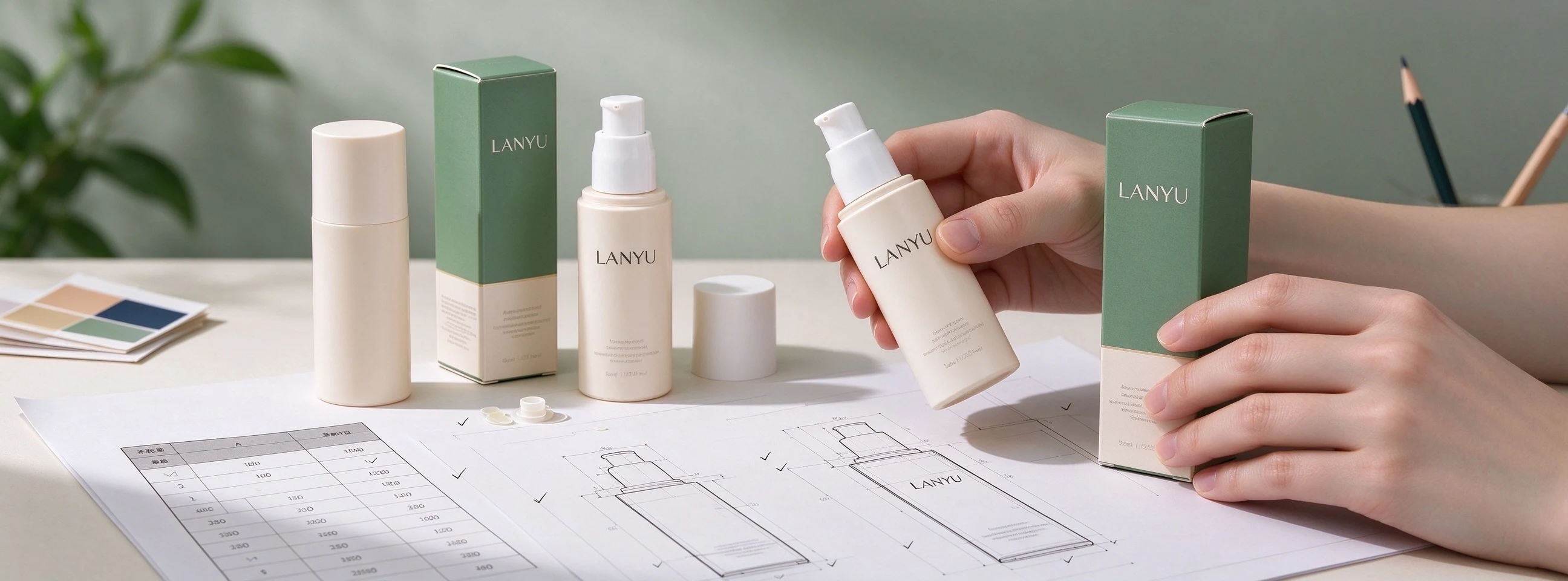
1. Identify what this sample can approve
Start by asking why the sample was made. A stock bottle may help you choose capacity and shape without representing the final colour. A printed mock-up may show artwork placement without using the proposed production finish. A prototype can support a structure discussion while leaving production-material performance unresolved.
Ask the supplier to state the sample’s purpose and any differences from the intended production pack. Write those differences beside its reference number. Do not rely on labels such as “final sample” unless both parties agree what final means.
- Stock sample: identify which existing features are representative and which will change.
- Visual or structural prototype: record the aspects it demonstrates and the materials or processes it does not represent.
- Decorated sample: identify the artwork revision, substrate and decoration process used.
- Proposed production reference: confirm its component specifications and any remaining differences or open checks.
These are practical descriptions, not a claim that every supplier uses the same sampling terminology. For custom tooling, keep the mold-development milestones distinct from approval of the finished packaging.
2. Build one approval reference
Samples often arrive before every document is settled. Before reviewing them, bring the references together: bottle drawing, closure specification, artwork file, finish reference, carton structure and insert drawing. Give each a revision or date.
Now check whether the physical sample corresponds to those references. A revised artwork file in an email does not automatically mean the bottle on your desk carries that revision. Mark mismatches explicitly instead of assuming the supplier will combine the correct parts of several conversations.
For multiple sizes, colours or language variants, keep a separate line for each SKU. If one sample is intended to represent a shared feature across several SKUs, name that feature and the SKUs it covers. Approval of one colour should not silently become approval of every colour in the order.
3. Review the complete pack, not a collection of parts
Lay out the bottle or jar, its closure, any protective component, the insert and the box. Assemble the version customers are intended to receive. Then review the handovers between components.
- Container to closure: check the specified combination and assembly arrangement. For pump-specific questions, use the pump and closure selection guide.
- Closure to presentation: check overall height, visible proportions and the intended transport position. Distinguish an acceptable collar gap from a suspected fit issue.
- Artwork to assembled pack: check readable text, selected revision, placement and how the bottle and box appear together. Use the hot-stamping review checklist for metallic details.
- Product to insert: confirm how the product sits, whether it can be removed as intended and whether contact points interfere with the finish or closure.
- Insert to box: review opening, closing and presentation using the intended components rather than an empty box alone.
Record the measurement method and acceptance criteria where dimensions matter. This guide does not assign a universal clearance or tolerance to every bottle and gift box. The carton sizing guide explains what to settle before approving the outer dimensions.
4. Separate appearance from performance
Use separate decisions for visual presentation, dimensional fit, dispensing, formula compatibility and transport performance. A photograph can help explain appearance; it cannot demonstrate all of those outcomes.
For each required check, identify the sample configuration, method, conditions, acceptance criteria, person responsible and result or outstanding action. If the brand’s formulation team or a laboratory performs part of the review, include its conclusion in the approval record rather than replacing it with a supplier’s visual assessment.
ISO/TR 18811:2018 describes a framework for cosmetic stability testing but does not prescribe one set of test conditions or acceptance criteria. That distinction matters here: selecting a test programme belongs to the responsible technical team, not to a generic sample checklist.
Approval of packaging appearance is not approval of formula stability, product safety or every shipping condition. Confirm the project’s required evidence and available inspection scope with the relevant parties.
5. Choose an unambiguous decision
A useful review ends with a decision, not just comments. Agree the meaning of your approval statuses with the supplier. One practical system is:
- Approved for the stated scope: identify exactly which sample and features are accepted.
- Revision required: list the changes, the owner of each action and whether a revised physical sample is needed.
- On hold: name the missing evidence or unresolved requirement and who must resolve it.
Keep production release as an explicit instruction. If only artwork is approved, say whether manufacturing must wait. Avoid “approved, but change the pump and box,” which combines permission with changes that could affect the assembly.
An illustrative situation: the bottle colour is accepted, but the insert holds the bottle at the wrong height. Record colour approval separately, request a revised insert and keep the assembled-pack decision open. That preserves the decision already made without treating the whole set as approved.
6. Write an approval record others can use
The goal is a record that a colleague can understand without reading weeks of messages. Include these fields in your email or project document:
- Project and SKU: product name, size and variant.
- Sample identity: sample reference, date received and photographs showing its label.
- Documents: drawing, artwork, closure and box revisions.
- Accepted scope: the specific features reviewed and approved.
- Open items: each issue, annotated evidence, responsible person and next action.
- Performance evidence: relevant report or review references and any outstanding results.
- Production release: yes or no, who authorised it and the date.
- Retained reference: who keeps the agreed physical sample and how it is identified.
For example: “Sample PA-03, 150 ml SKU: bottle appearance accepted against colour reference C-02 and artwork revision B. Insert revision 2 requires adjustment at the marked contact point. Complete-pack approval is on hold. Production is not released.” This is an example of clear wording, not a customer case or a standard LANYU form.
Ask the supplier to acknowledge the same references and next actions. Store the final decision together with the supporting files, not as a detached screenshot that loses its project context.
7. Reopen the right checks after a change
A later change should not erase the whole approval history, but it may affect more than the changed part. Replacing a closure can affect overall height and insert fit. Changing a surface finish can affect appearance and handling requirements. A new artwork revision can change the print area without changing the bottle.
Log what changed, why, which document replaces the previous version and which approvals need review. Ask the relevant technical team to decide what evidence must be repeated; do not assume that a visually similar substitute is equivalent.
Keep approved and superseded samples clearly separated. An agreed physical reference is useful for comparison, but it does not replace written specifications or production inspection. Before release, connect the reference to the project quality requirements that will guide production review.
Questions before production release
Can we approve everything from photographs?
Photographs are useful for communication and some visual decisions. They do not establish tactile qualities, mechanical fit or formula performance. Agree where physical samples and technical evidence are needed.
Does approving a sample guarantee every production unit will be identical?
No. Sample approval establishes a reference and an agreed scope. Production still needs defined specifications, acceptance criteria and an inspection arrangement appropriate to the order.
Do we need to repeat every check after a small change?
Not automatically. First identify what the change could affect, then agree the checks needed to support the revised configuration. Record that decision rather than leaving it implicit.
What if our launch date arrives before all checks are complete?
Identify the unresolved items and their consequences with the responsible teams. A deadline is not evidence that a sample meets the requirements. Keep any release decision explicit and separate from general enthusiasm about the design.
Make the next sampling round easier to approve
Send the current component references, artwork revision and a short list of open questions. Tell us what the next sample needs to demonstrate so the review has a clear purpose.
Discuss Your Sampling Requirements